 Jumper
 connects token swaps and cross-chain transfers with access to DeFi yield.
Jumper combines same-chain token swaps, cross-chain bridging, and access to decentralized finance (DeFi) yield through one interface. A liquidity aggregator handles its routing, while Earn connects supported assets to third-party yield positions. Available routes, received amounts, and costs depend on the selected tokens, networks, and providers.
In short: Bridge fees and source-chain gas affect transfer costs; Earn deposits also inherit the selected yield protocol's risks and withdrawal conditions.
Source Assets and Destination Networks
The source token, input amount, and destination network determine which routes Jumper can quote. Same-chain swaps change the asset within a network, while bridging moves value between networks and can include token conversions. Liquidity determines whether providers can fulfill the requested transfer and influences its quoted output. Changing the amount can change the available providers, price impact, and economically viable routes.
The destination asset needs its exact network identity. Tokens that share a symbol can have different contract addresses or bridge representations. Those differences matter when another application accepts a particular token, so a route identifies the output asset alongside its destination chain. Wallet compatibility also matters: the connected wallet must support the authorization that the selected route requires, and the receiving address must meet that provider's destination requirements.
Routing Across Swaps and Bridges
The liquidity aggregator connects Jumper to decentralized exchanges, bridges, and solver liquidity. A decentralized exchange trades tokens through on-chain liquidity, while a bridge moves value between blockchain networks. Aggregation brings available paths into a common interface, allowing comparison of quoted output, costs, and estimated execution time. Jumper Advanced is an alternative trading interface with quote simulation, smart slippage, large-order splitting, and advanced limit orders.
A cross-chain route can include a source swap, bridging, and a destination swap when those operations are needed. Several contract calls can share a submitted transaction; other routes require an additional transaction on the destination network. The selected route determines these execution requirements; the number of conceptual operations alone does not establish the number of signatures.
Solver-based routes use intents, which express the requested outcome without specifying every execution detail. A solver supplies destination assets using its liquidity, with settlement governed by the relevant contracts. Available routes follow active solver inventory. In the intent system used by Jumper, gasless order submission can coexist with paid on-chain approvals or funding actions.
ERC-20 tokens can require a spending allowance before a contract transfers them. An approval grants permission to a specific spender; executing the swap or bridge is a separate action. Some authorization methods use signed messages. Their spender, amount, and any expiry define the spending permission.
A successful source transaction confirms source-side execution, while cross-chain completion also requires the destination outcome. The recorded receiving token and amount establish what arrived, while an earlier quote remains an estimate.
What Does a Route Quote Include?
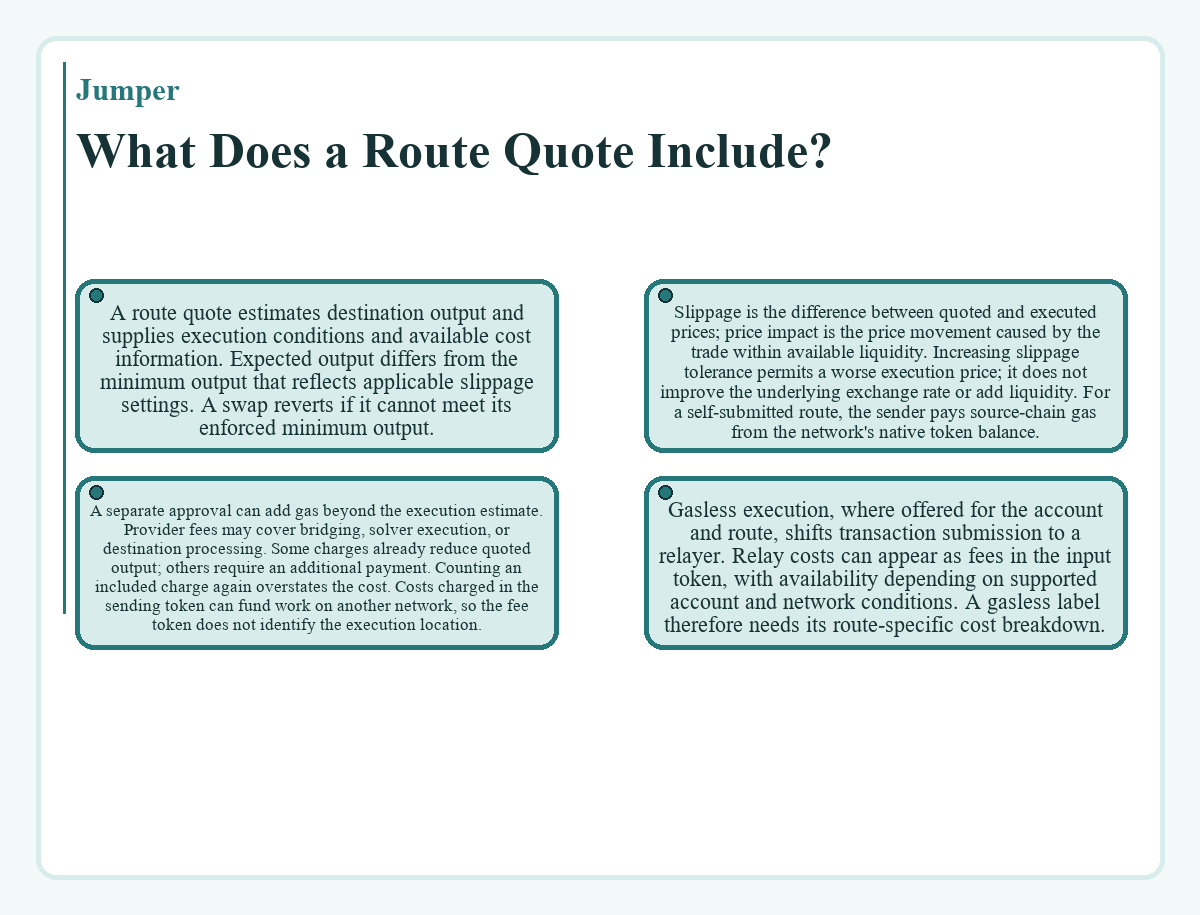
A route quote estimates destination output and supplies execution conditions and available cost information. Expected output differs from the minimum output that reflects applicable slippage settings. A swap reverts if it cannot meet its enforced minimum output. Slippage is the difference between quoted and executed prices; price impact is the price movement caused by the trade within available liquidity. Increasing slippage tolerance permits a worse execution price; it does not improve the underlying exchange rate or add liquidity.
For a self-submitted route, the sender pays source-chain gas from the network's native token balance. A separate approval can add gas beyond the execution estimate. Provider fees may cover bridging, solver execution, or destination processing. Some charges already reduce quoted output; others require an additional payment. Counting an included charge again overstates the cost. Costs charged in the sending token can fund work on another network, so the fee token does not identify the execution location.
Gasless execution, where offered for the account and route, shifts transaction submission to a relayer. Relay costs can appear as fees in the input token, with availability depending on supported account and network conditions. A gasless label therefore needs its route-specific cost breakdown.
Earn Deposits and Yield Conditions
Jumper Earn provides discovery and deposit access to supported DeFi yield opportunities. Its catalog includes lending and staking positions, with integrations such as Aave, Morpho, and Lido. Jumper Earn uses Composer to execute Quick Deposit flows. These flows coordinate the conversions, bridging when required, and protocol deposit needed for a supported entry. Composer currently supports only chains compatible with the Ethereum Virtual Machine (EVM). Deposits must return a token representing the position. A deposit creates a position in the selected protocol, whose rules govern the assets afterward.
Annual percentage yield (APY) expresses an annualized yield estimate that accounts for compounding. The displayed rate can change, and historical yield does not establish future earnings. Total value locked (TVL) describes a market's or vault's deposited capital, giving context about its size. Capital remains exposed to the selected protocol's contracts and strategy, as well as changes in the value of the underlying assets.
Catalog coverage follows indexed opportunities, and a supported protocol can have markets that do not appear. Entry availability also requires an executable route into the particular position.
Portfolio Position Tracking
Jumper Portfolio groups supported DeFi positions across networks, showing balances and returns within the same application. It provides a view of assets already deployed into protocols, alongside available deposit, withdrawal, and redeployment functions. Deposit-only Composer integrations require withdrawals through the protocol's own interface. Each underlying protocol determines its exit conditions, so position value and immediately withdrawable assets can differ. Reading holdings uses the wallet's public address; moving assets requires the relevant authorization. Public-ledger balances and transactions remain visible to others who know that address.
Dust Sweeper Consolidation
Dust Sweeper converts selected small token balances on a supported chain into that chain's native asset. These leftovers often accumulate after other token activity. Composer coordinates their consolidation, with required approvals depending on existing allowances. The sweep operates within the selected chain, and tokens that cannot be routed can be excluded from the proposed sweep. Execution costs and price impact affect how much value consolidation recovers, making the quoted net output relevant even when each starting balance is small.
Transfer and Deposit Requirements
The intended destination determines whether a token transfer or an Earn deposit meets the task. A transfer delivers an asset to a receiving address. A deposit also enters a selected yield position. The quote needs to match the exact asset, route costs, and destination requirements.
- For a transfer, match the destination network, receiving address, and exact output token to its intended use.
- For an Earn deposit, confirm that the entry route supports the selected position and required underlying asset.
- For a self-submitted route, retain enough native gas on the source chain and any destination chain where you must submit a transaction.
- For a token approval or signed authorization, inspect the spending contract, permitted amount, and any expiry.
- For a yield position, consider withdrawal conditions and protocol exposure alongside its displayed APY.
A bridge can deliver the bridged asset even when a later protocol call fails. Deposit completion requires successful entry into the position, making its outcome distinct from arrival on the destination network.
A change in the output token, destination network, input amount, or selected position calls for a fresh quote. Liquidity and account eligibility can also change available paths. If the revised route changes costs, permissions, or the destination asset, the earlier conditions no longer describe that execution.
Jumper questions worth asking
Why Can a Token Appear in My Wallet but Not in Jumper Search?
A wallet balance can exist even when the token is absent from the default search list. Token lists use validity, listing, and spam filters. Searching by the correct contract address on its network can locate additional assets. A matching token still needs available liquidity and an executable route; appearing in search does not establish that a transfer can proceed.
How Long Does a cross-chain Transfer Through Jumper Take?
Transfer time depends on the selected provider, required source confirmations, and destination processing. The route's duration is an estimate for that path. Congestion or temporary bridge availability problems can delay completion. A source transaction hash identifies the submitted transaction; destination delivery remains a separate state that the transfer status must establish.
What Happens If the Destination Swap Fails After Bridging?
A successful bridge followed by a failed destination swap can leave the bridged asset at the destination. The route can finish partially, with a different token from the requested output. Other failures have provider-specific refund behavior. The received asset and transfer status determine the outcome; a failed destination swap does not automatically mean the source transfer reversed.
Can a Token Transfer Be Authorized Without a Separate Approval Transaction?
Some supported token and route combinations use signed permits instead of a separate approval transaction. Native permits require token support for EIP-2612. Permit2 uses an initial on-chain token approval, followed by signatures authorizing individual transfers. The available flow depends on the token, allowance state, and integration; signing a message can still grant spending permission.
Does Dust Sweeper Always Require Just One Wallet Confirmation?
Dust Sweeper can require token approvals before its consolidation transaction. New tokens can need allowances for the per-user execution proxy. Existing approvals can persist across sweeps, reducing later confirmation requirements. A single consolidation transaction describes the bundled swaps; it does not establish that every selected token already has the spending authorization needed for that transaction.