 Jumper
Jumper Earn connects vault yield comparisons with deposits into positions that retain their protocol's withdrawal rules.
Jumper Earn lets you compare vault yield data and use Quick Deposit to enter supported decentralized finance (DeFi) positions. A meaningful comparison includes the deposit asset, yield source, historical rate, and withdrawal conditions. Compatible deposits can include token swaps and cross-chain bridging before funds enter the selected protocol. That protocol controls the position's yield and redemption rules. Jumper Portfolio provides a consolidated view of supported positions, including access to supported deposit and withdrawal actions.
Vault Assets and Yield Strategies
A vault's underlying asset and strategy determine the exposure that accompanies its yield, including the risks that can reduce its value. Earn brings opportunities from protocols including Aave, Morpho, and Lido into a common interface. Filtering by asset, chain, and protocol narrows the comparison to relevant positions. The deposit asset identifies what the strategy accepts; the source asset identifies what the wallet contributes through a compatible route.
Lending Allocations
Aave suppliers earn interest from lending pools, where borrowing utilization measures the proportion of supplied assets that borrowers currently use, and both utilization and governance parameters help determine the rate that suppliers receive. Morpho Vault V1 allocates deposits across selected variable-rate lending markets. Its curator defines the permitted markets, while allocation decisions govern where funds earn interest. Different vaults can expose the same deposit asset to different collateral, liquidity conditions, and fees.
Staking Exposure
Lido's liquid staking connects a tokenized position to Ethereum staking rewards and penalties. This exposure differs from lending yield paid by borrowers. The position's token structure also affects how earnings appear in a balance. Comparing these strategies solely through an annualized percentage leaves out the mechanism that produces the return and the method that converts the position back into usable assets.
Withdrawal Liquidity and Redemption Methods
Withdrawal terms determine whether a position returns underlying assets immediately, waits for available liquidity, or enters a redemption queue. The selected protocol and position govern these conditions, including any additional restrictions.
Lending Withdrawals
Aave withdrawals require enough unborrowed liquidity in the selected pool. If supplied assets also secure an active borrow position, withdrawing them must preserve the required collateral coverage. The amount that can leave the pool therefore reflects both available liquidity and any applicable borrowing constraints.
Morpho Vault V1 draws withdrawal liquidity from markets in its configured withdrawal queue, an ordered list of funding sources. Morpho Vault V2 uses a different structure: idle assets and, when configured, a designated liquidity adapter serve ordinary withdrawals. Accessing liquidity in other allocations may require forced deallocation, which can incur a vault-configured penalty. V2 access gates, which enforce withdrawal permissions, can block ordinary and in-kind exits. In-kind redemption can transfer an illiquid remainder from V1 or supported V2 vaults into underlying lending positions. That outcome still leaves access to the underlying asset dependent on market liquidity.
Staking Withdrawals
Lido's native withdrawal process requires a request, finalization, and a subsequent claim of ETH. Queue demand, available protocol funds, and validator exits affect timing. The withdrawal claim excludes staking rewards earned during the queue period, and penalties can reduce the claimable amount. Selling a staking token through an available market follows a separate path, with execution governed by liquidity and price. These alternatives have different timing and received-value conditions. Their availability through a particular Jumper route must match the position and supported action.
APY Windows and Incentive Terms
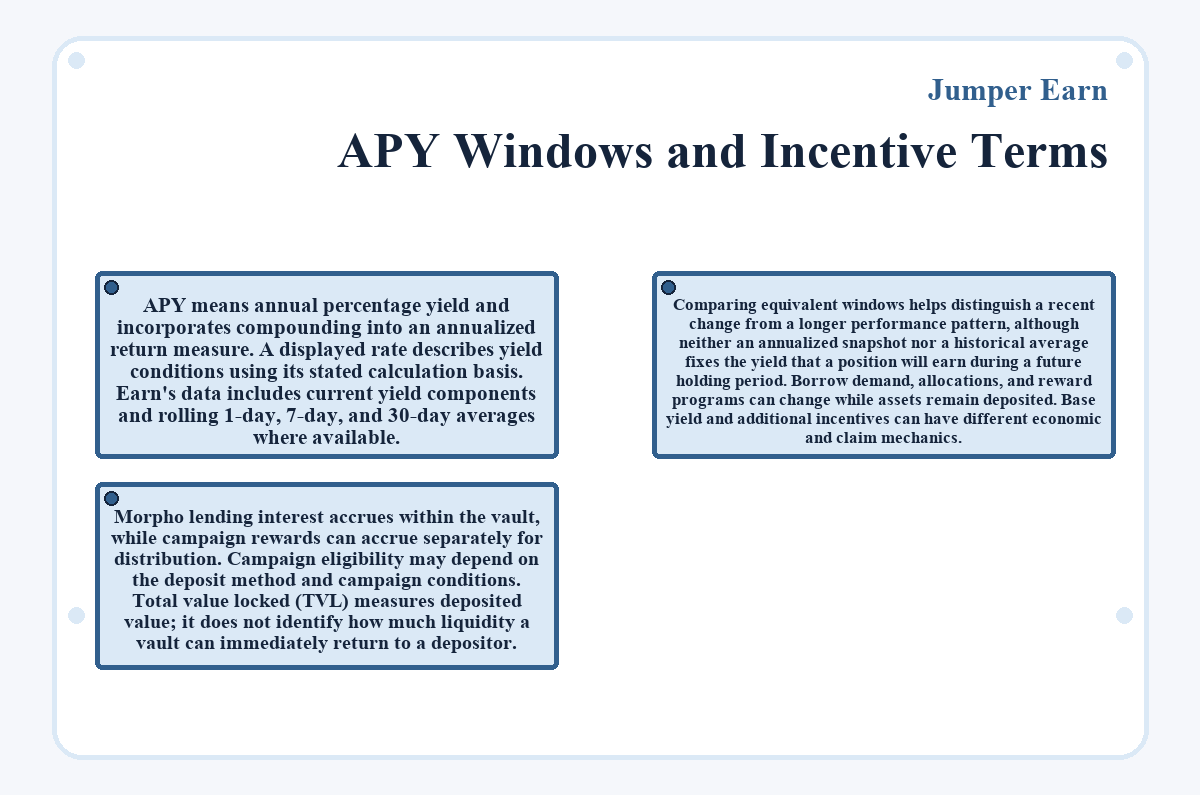
APY means annual percentage yield and incorporates compounding into an annualized return measure. A displayed rate describes yield conditions using its stated calculation basis. Earn's data includes current yield components and rolling 1-day, 7-day, and 30-day averages where available. Comparing equivalent windows helps distinguish a recent change from a longer performance pattern, although neither an annualized snapshot nor a historical average fixes the yield that a position will earn during a future holding period. Borrow demand, allocations, and reward programs can change while assets remain deposited.
Base yield and additional incentives can have different economic and claim mechanics. Morpho lending interest accrues within the vault, while campaign rewards can accrue separately for distribution. Campaign eligibility may depend on the deposit method and campaign conditions. Total value locked (TVL) measures deposited value; it does not identify how much liquidity a vault can immediately return to a depositor.
Quick Deposit Quotes and Position Costs
Quick Deposit uses Composer to connect a compatible source asset with a supported yield position. Composer is limited to Ethereum Virtual Machine (EVM) chains and protocols that issue a position token on deposit. Routes can include token swaps and bridging to reach the vault's required asset and network.
Routing and Authorizations
Token authorization permits a contract to spend an asset; it does not establish that the deposit has completed. Required authorizations depend on the asset and execution path. Cross-chain deposits through Composer execute in source-chain and destination-chain phases. Atomic execution applies to each chain's phase separately. If the bridge succeeds but the destination deposit fails, bridged tokens can remain in the destination wallet without a vault position. The destination position must be established before a cross-chain transfer counts as a completed vault deposit.
Quoted Output
Route costs can include network gas, swap or bridge charges, and any integrator fee listed in the quote. Slippage tolerance sets the permitted difference between quoted and execution output, while price impact describes how the trade itself changes its execution price as it draws on the liquidity that a route uses. The expected position token and minimum received amount belong to the particular quote. These values can change when the input amount, market liquidity, or route changes, even when the destination vault remains the same.
Vault Fees
Vault fees have their own calculation bases. Morpho Vault V1 uses a performance fee on accrued interest. V2 can also charge a management fee against total assets. The selected vault's settings determine the applicable rates. Compare yield figures on a consistent fee basis, and account separately for entry and exit costs. Repeated repositioning adds execution costs that an annualized rate comparison alone does not capture.
A Partial Redemption After Liquidity Falls
In this hypothetical case, a lending position accessed through Earn is worth 137 units of its underlying asset, initially with sufficient withdrawal liquidity. Before redemption, available liquidity falls to 117 units. Hold the position valuation constant and exclude fees and intervening interest from the arithmetic.
The reader chooses an available partial-redemption method for 117 units. In this case, successful execution delivers 117 underlying-asset units to the wallet, leaving a position worth 20 units: 137 minus 117. The receipt balance decreases to reflect the redeemed portion. The wallet's received asset and the remaining position reconcile the outcome. A submitted request or signature alone would establish neither result.
The partial redemption releases the available amount while the remainder stays exposed to the lending strategy. Waiting instead preserves the full position until sufficient liquidity supports the desired withdrawal. Keeping liquidity at 137 units would allow a full redemption under the same assumptions and other applicable withdrawal conditions.
Receipt Balances and Realized Yield
A receipt token represents an interest in the underlying position, with its own conversion relationship to the deposited asset. Accrued lending interest increases the underlying-asset value represented by each Morpho Vault V1 share. The number of shares can stay unchanged while their asset value grows. Lido's wstETH similarly reflects staking rewards through its conversion relationship with stETH. Comparing receipt-token units directly with deposited-asset units would mix different denominations.
Jumper Portfolio helps track supported positions, but a displayed valuation differs from assets already redeemed into a wallet. Realized proceeds reflect the completed withdrawal method and any conversion costs. When a position changes during the holding period, rate history explains only part of the outcome: the underlying asset value, vault fees, and redemption terms also matter. A higher quoted yield can therefore accompany a position whose exit liquidity or reward eligibility has changed.
Jumper Earn: reader questions
Why Is a Vault Missing From Jumper Earn Even Though Its Protocol Is Listed?
Earn displays indexed opportunities, so a listed protocol does not imply complete coverage of all its vaults. Discovery depends on the vault data that the aggregation pipeline has indexed. A missing listing therefore does not establish that the protocol has closed the vault. Its availability and its inclusion in Earn are separate matters.
Can an Earn Vault Require Identity Verification Before a Deposit?
Vault-specific identity verification can apply where the underlying product requires it. Earn's data model includes a KYC indicator for this requirement when available. KYC means know your customer. Connecting a wallet does not establish eligibility for a restricted product, and the access conditions of another vault cannot establish eligibility for the selected position.
Does a Successful Quick Deposit Automatically Claim Separate Reward Tokens?
Separate reward tokens follow the campaign's distribution and claim rules, including when deposits use Quick Deposit. For current Morpho incentive campaigns, Merkl distributes rewards through a separate claim process. Lending interest accrues within the vault's asset value. Claimable incentives and tokens already received in the wallet therefore represent different balances.
Is Deposit Support Enough to Confirm a Withdrawal Route for the Same Earn Vault?
Deposit support and redemption support are separate capabilities in Earn's execution data. A deposit route therefore does not establish that Jumper can execute the corresponding withdrawal. The underlying protocol may provide a redemption method with different requirements. Route availability, protocol access, and withdrawal liquidity each describe a different constraint on that position.
What Does a Missing Dollar Valuation Mean for an Earn Position?
A missing dollar valuation can reflect an unavailable asset price. Earn's portfolio data permits that value to be empty when pricing is unavailable. The missing valuation does not establish that the position balance has disappeared. Receipt-token balances and underlying-asset conversion values provide different information from a dollar price, especially when reconciling a supported position.